A paper-based packaging proposal needs to answer at least two different questions: does the finished construction provide the protection the application requires, and what evidence supports its intended recycling route? A material description cannot settle both. Public research offers useful examples of why these reviews should remain separate.
Oxygen and moisture are separate specifications
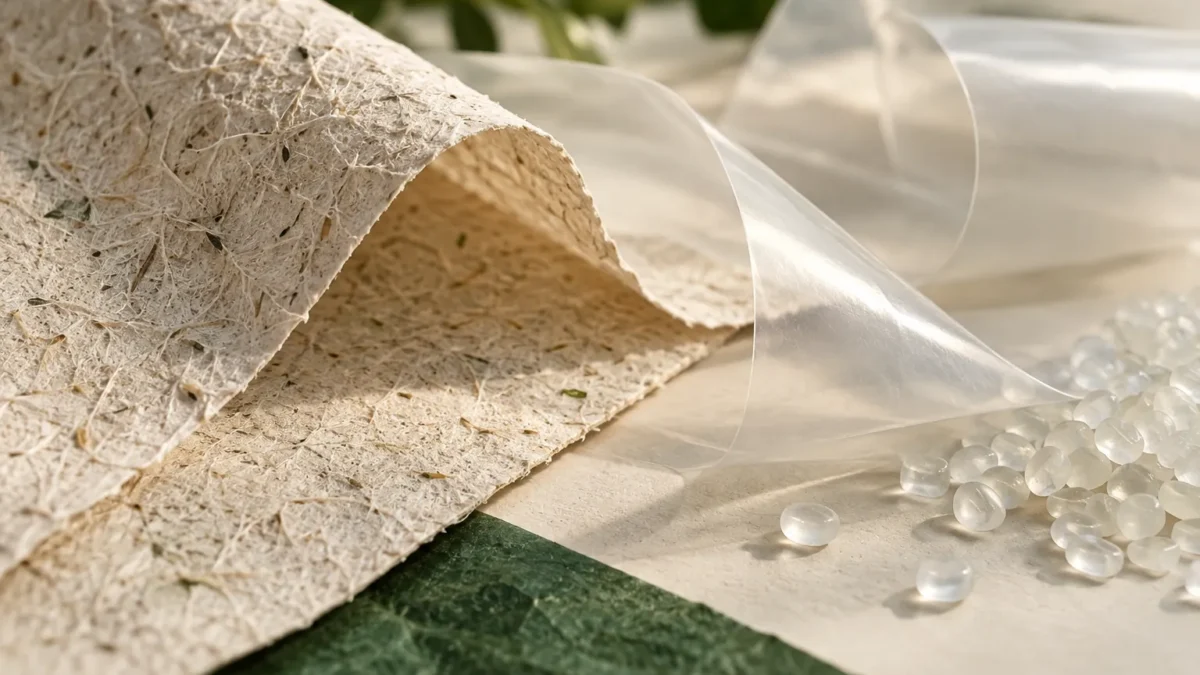
A 2026 review hosted by the US Forest Service examines films combining cellulose-nanomaterial cores with plastic outer layers. It describes complementary roles: the core provides an oxygen barrier, while the outer layers protect against water vapour. The authors identify moisture sensitivity, scale-up and standardisation among remaining challenges. This is a research review, not a specification for every paper-based pack.
For procurement, the first step is to translate the application into a written requirement. Which property is needed, under what conditions, for how long, and on which finished construction? Comparing two supplier values is useful only when the measurement method, conditions and specimen are comparable.
An oxygen figure should not be substituted for a moisture result. Nor should a flat-material test automatically stand in for validation of a filled and sealed pack. The purchasing record should make clear whether the evidence concerns a material sample, a converted package or the complete intended application.
Construction can change the result
A 2022 Forest Service-indexed study investigated coatings on paper with a cellulose-nanofibre layer. Double-layer samples showed lower moisture transmission than single-layer systems in the studied constructions, while hot-pressing two dry layers did not improve performance over a single layer. The result illustrates the importance of construction and processing; it is not a universal rule for adding layers.
Useful supplier documentation would therefore identify substrate, coating formulation, coat weight, layer arrangement and conversion steps. If a proposal changes one of these, a buyer should ask which previous test results still apply and which require fresh validation. This is a specification-management question rather than an assumption that more coating is always better.
Barrier performance does not establish recyclability
The 2026 review reports laboratory-scale separation of cellulose-core/plastic-layer structures in water. Separately, a December 2022 paperboard-coating study examined gas barriers and removal of a particular waterborne coating in alkaline solution. Those are defined research conditions. Neither establishes that all coated paper packaging is accepted or efficiently processed in a local collection and recycling system.
A recycling review should name the whole construction, the assessment method and the intended route. Ask whether its evidence concerns laboratory disintegration, material separation, fibre recovery, product-quality effects or operation at industrial scale. These are useful distinctions to record, rather than interchangeable labels.
A short evidence checklist
- Record oxygen and water-vapour performance separately, with test conditions and specimen details.
- Keep a complete construction specification, including coatings, adhesives and any plastic layers.
- Identify whether package-level conversion and sealing were included in performance validation.
- State exactly what the recycling test measured and what processing route it represents.
- Recheck the evidence when materials, coating weights or conversion settings change.
For a buyer, a strong submission is one that makes its boundaries visible. It connects an intended use to measured performance and identifies a credible route for the exact construction after use. A promising laboratory result can justify further work without being presented as a market-wide recycling conclusion.
The practical lesson is to evaluate the finished pack through two evidence tracks. Protection requirements guide performance testing. The proposed collection and processing route guides end-of-life assessment. A paper-based appearance is useful information about design, but it is not a substitute for either record.
Sources
US Forest Service: multilayer-film review (2026); US Forest Service: double-layer coating study (2022); Eindhoven University of Technology: paperboard-coating study (December 2022). Checked 14 October 2026. Publication years are recorded where the repository does not provide a verified day.
Continue reading: materials coverage and reading footprint comparisons.
Submissions are temporarily inactive. Read our corrections policy.